No trip to South Georgia would be complete without a visit to Grytviken. Here the whaling station has been cleaned up. The asbestos and dangerous items removed or tidied away and the harbour cleared of underwater detritus. Grytviken is a whaling station museum. The Europa can safely anchor here. The shelter is generally good.
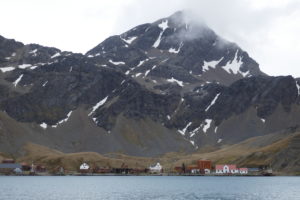
A headland juts out to one side of the bay. King Edward Point. From here the representatives of the Queen and Great Britain run the dependency and ensure law, order and conservation are administered as required by the Crown. The buildings are neat, trim and look new. The flag of South Georgia flies proudly from the flagstaff. (For those flag nerds amongst you, it’s a defaced blue ensign with the arms of South Georgia containing a seal, a penguin and a reindeer) On questioning why the reindeer still graces the crest, now they have been eradicated, the top man told me the UK has no native lions or unicorns either. He has a point. Here also is the British Antarctic Survey base where scientists and researchers come to count seals, birds and carry out other valuable activities. In total, 30 people, with a handful more on another base on adjacent Bird Island. And this is the summer. In winter the population reaches 8.
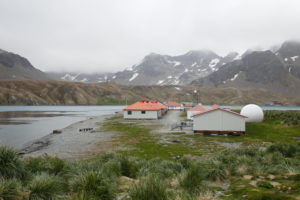
Once a year a ship carrying supplies visits the island delivering important cargo. It arrived a couple of days before us, so were advised to break the law as the gaol (an establishment required by the crown) doubles up as the alcohol store ! Sounded like some drinking would be required to make standing room. Outside a residential unit 24 cans of tonic sat in the cold awaiting the gin.
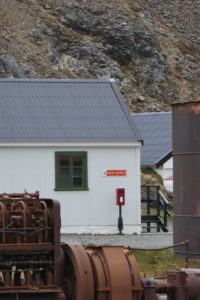
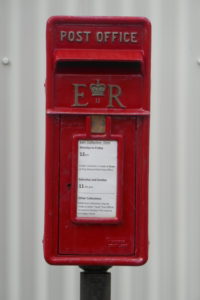
There is a post office here selling cards, souvenirs and South Georgia stamps. Rare indeed and philatelists covet issues from this newly refurbished little hut. On the end of the counter I can’t resist adding a rubber stamp of a whale to a few of the cards I send. You can’t have too much wildlife here. Passing ships take the mail to the Falkland Islands 900 miles away and then it’s sent to the UK to link with the Royal Mail. A fisheries protection vessel is due a few days after we leave, so I’m hopeful mine make it for Christmas.
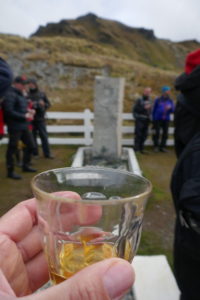
The bay has a number of visitor attractions. We begin with a visit to the graveyard, where Norwegian whalers who met their end here are buried. At the head of the white picket fence enclosure stands the much photographed grave of Sir Ernest Shackleton, the famous polar explorer. Next to him a stone laid in 2011 commemorates Frank Wild, ‘his right hand man’, though why it’s on his left side, we don’t know… As is customary, we toast their memories with a tot of whisky, thoughtfully provided by the Europa crew.
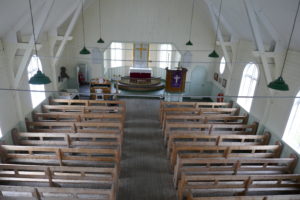
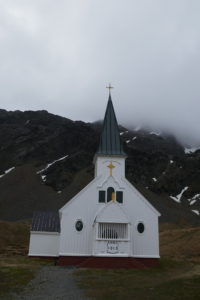
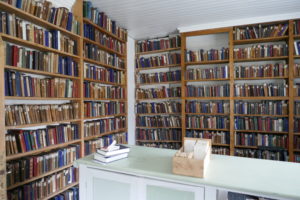
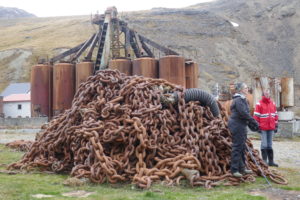
This is followed by a guided tour of the station by a jolly enthusiastic English woman. She brings to life the cold, blood, guts and genuine hardship of the whalers’ lot. 12 hour shifts, few women, bunkhouse accommodation with scant facilities (i.e. cold water only in another block). Makes our ship seem like a palace for a moment ! There was a cinema and a football pitch, but little else. A pretty wooden church with huge windows overlooks the settlement. Out the back is a delightful library. We ring the bells gently, but resist a sing-song at the organ. The small museum is jammed with artefacts and pictures to complete the picture. I recoil at two iron harpoon heads, about 5ft long, bent out of shape from impact with huge whales. Back in the day a blacksmith was permanently employed to persuade them back into shape. It’s hard to appreciate this cruel industry today. Without petrochemicals whales provided a wealth of raw materials for daily life. An old ledger found onsite lists the purchases made by the working men. Tobacco is understandably high on the list, closely followed by cologne. Not for chasing the ladies with, but for drinking. The station manager did not want alcohol to get in the way of work, so they had to find other ways to get their kicks. I shudder to think what else they turned to when the cologne ran out.
A replica of the ‘James Caird’ is displayed here. This is the 20ft boat Shackleton and 5 of his men navigated 900 miles from Elephant Island to South Georgia in order to get help for their failed expedition to the South Pole in 1916. We are invited to look inside. The seas around here are ruthlessly harsh and unforgiving and this is no bigger than a large rowing boat with a cover. It brings home just what a feat of unbelievable endurance this was. I was in awe before I saw it. Now I’m flabbergasted.
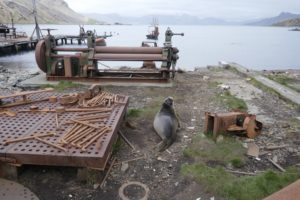
Walking around these whaling stations is a health & safety nightmare. Bits of rusty ironwork jut out of the soil and whalebones litter the ground. It’s not just the lazing seals you need to look out for. In the early days whales were killed for oil & blubber, but later a law ensured all the whale was used for something, driving up the killing. Those early whalebones are testament to the early waste.
After an afternoon taking all this in, we repair to the Europa and find the crew have been busy bringing us back to the 21st century. It may be only a few degrees above freezing, but the canopy is up, fairy lights in the rig, music playing and a BBQ underway. Party time ! Special guests from the base and town are invited aboard and we grill them about their lives here. Simon, an ex-Army officer who appears to be in charge, tells me he wears many hats. I forget them all but policeman, fisheries protection, gaoler, Harbour Master, Queen’s representative are a few. He is also a trained marksman and responsible for removing the last few reindeer on the island. One of his colleagues gives me a good tip for dealing with aggressive fur seal bulls – take a long stick and tickle their whiskers or under the chin. Simple ! Our guides didn’t tell us that one, but after a few hairy encounters, I’m not about to try.
As the evening wears on and some of my fellow passengers are dancing the night away on deck, I slip quietly into my bunk, reflecting that of the 30 people in Grytviken, probably 10 of them are aboard our ship and there are 60 of us here already. No wonder they like to know when we are coming !