Alice, Alice, who the heck is Alice ? I hear you cry.
History paragraph: Well, she was the wife of the man tasked with bringing the telegraph through central Australia. The town was originally called ‘Stuart’ after John McDowell Stuart who led an expedition through Australia from south to north. This paved the way for the telegraph station, connecting the continent via Java and opening up efficient communication with the rest of the world. Efficient for 1872. And it won Stuart a prize of £2,000 at the time. The indigenous (Aboriginals) people were less impressed. In 1933 the name ‘Alice Springs’ was adopted in view of the abundance of underground springs here. By 1967 Alice had fibre optics, cables and satellite communications. With a population of 27,000 it’s not big, but serves tourists and the outback communities. When you farm an area of anything up to 20,000sq kms (think Sicily), you are a long way from help and resources. Many have their own airstrips.
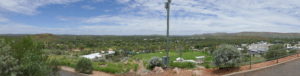
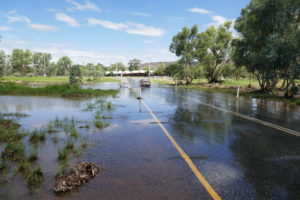
This is the Red Centre. But today it’s quite green. Flying in from the west, there is green vegetation everywhere. Approaching my accommodation people were swimming in water holes. The road was flooded at the end of the street. In my little cabin, the local map shows “course of Todd River, usually dry”. All the plants have that pale green, spring like look about them. Unusual. I’m told many months worth of rain has fallen in the last few days. So much so my first excursion is cancelled on the day. Roads through the canyon closed. Ho hum. In August it’s so dry the locals throw the ‘Henley on Todd regatta’ on the river bed, with various silly homemade ‘craft. I see a few pictures and it looks appealingly bonkers.

Half a day at a wildlife park is little consolation, but enjoyable enough. I see lots of native birds, plants and animals close up. A talk by a local Aborigine about the ways of his people and other native Australians is fascinating. I learn a lot. There are historically c250 indigenous groups (or tribes) across Australia and each has its’ own language and strict codes of conduct. Bruce (yes, really) told us of their ways, how they live by what their elders decree, even down to a very rigid policy on who can marry who, in order to avoid genetic issues from interbreeding (you do not marry outside of the ‘skin’ group). They also maintain numbers of children, although I didn’t quite get how. But it works. They are traditionally hunter/gatherers, with clear divides on ‘women’s work’ and ‘man’s work’. Nomadic, they rotate their living spaces at regular intervals, each group in the tribe applying their special skills to the area, so a kind of ‘crop rotation’ evolved where some would burn the vegetation to clear the area for new plants to grow (many Australian plant seeds need fire to germinate them) The next group might harvest the seeds from those plants etc.
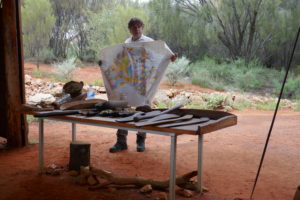
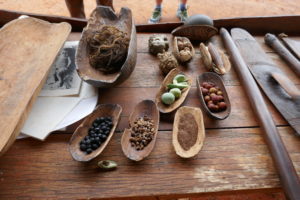
After thousands of years living on the continent, much knowledge and experience has been honed to a fine art & handed down. We Westerners arrived a few hundred years ago and cheerfully upset all of that. Bruce believes there is a way forward for both cultures, if we accept and respect each other. He is a refreshingly positive man.

Back in town I’m hungry. I have a mooch around and head to a reserve at the end of the road. But it’s Sunday and Alice appears to be shut. Every cafe, restaurant, bar and almost all shops are either boarded up or simply closed. Even the reserve is deserted; the cafe closed for January and the kiosk unmanned. At least the gate is open ! I decide to walk through it & head back to the hotel with my snacks and hit the pool to cool off. It’s in the high 30’s and very dry. Seeing a sign warning of snakes I’m checking the path. I look up and 3m in front of me is a kangaroo with a big Joey in her pouch, upwind, curious, but unafraid. Another wild encounter (they can jump these fences). We eye each other quietly for 15 mins or so before she moves away, unhurried. Magical.

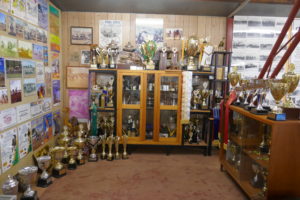
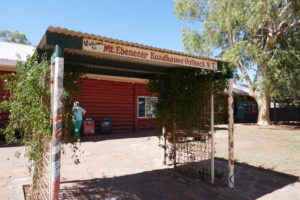
Afghan camel drivers plied their transport around here for many years, moving goods around the country via Dromedary. When the railway arrived in Alice Springs, they were out of business, but the service is to this day known as ‘The Ghan’ in recognition. I can hear the whistle as the train approaches town. There is now a huge wild camel population, roaming across Australia. In a few places camel farms offer rides to tourists. Each year there is a big race event here. In a roadhouse stop/camel farm there is a cabinet bursting with trophies. Camels are clearly big business here.
Next day I’m up early and on the coach ride to Uluru and the real Red Centre. This takes several hours and the landscape changes subtly. Road trains go past occasionally and truck stops are equally huge to accommodate them. The biggest ones can guzzle 1ltr of fuel per km travelled. Our driver is a natural narrator and educates us as he negotiates poker straight tarmac. When he’s not speaking we are serenaded with country & western and Elvis. Uh-huh.
I have a pretty sure idea who Alice is…!! 😉 xxx
Haha!! My favourite blogger !!!