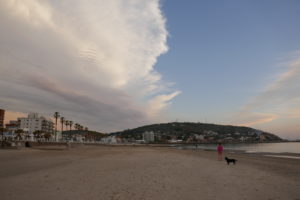
Piriapolis is an interesting resort for South America in that it faces west. Most places on the Atlantic coast of South America face east, which is great for a sunrise.
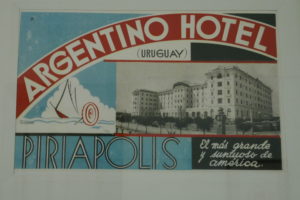
Back in the day when Uruguay was an emerging nation, Francisco Piria came to the south eastern corner of Uruguay with a vision. Not sure if it was the weather, the beaches (they are very good) or the reputed mystical energy but as an entrepreneur and all round clever guy, he saw an opportunity and capitalised on it. A sleepy village with a few fisherman rapidly became a chi-chi seaside resort, focusing on the main bay and beach. A ‘rambla’ (promenade) was constructed and the magnificent and then exclusive Hotel Argentino built on the front, looking out to sea. There was a narrow gauge railway spur from the main line between Montevideo and Punta del Este to the east to bring in the punters. Plans were drawn up for the whole town to his designs.
Piria’s dream was based on alchemy and mysticism and there are a number of important sites in and around the town. On the seafront above the original fishermen’s huts, looking out to sea is a statue of indeterminate gender, with bulls horns at its’ feet. This is to safeguard the people who live and work with the sea. I’m hoping he/she will be on duty as we sail past next week. Certainly the fisherman are thriving under her/his gaze. Their womenfolk make a mean seaweed dumpling.
A park not far away houses a white circular structure with a replica of a Milanese statue of Venus, said to have special powers. It’s surrounded by a shallow pool and a circular gravel path. Walk once around the pool anti-clockwise and focus your thoughts on good things. Press repeat, thinking of good things for others in your life. Two fountains with a male and female head deliver spring water. Once around a second time you choose which energy you need (male or female) and take a drink. Nice water, but no vibes for me. Ho hum.
Up in the hills sits a large concrete puma and below him a life-size bronze bull (impressive fellow) spouts pure spring water over a pretty waterfall created in the hillside. On top of the hill, there is a circular chapel with fresh floral offerings and the remains of another statue, but a week before I arrived a huge storm ripped through the town, bringing down trees, tearing up roofs and undermining some of the delightful rambla. The statue was a casualty, but on the plus side the new McDonalds on the front was damaged too. I like to think Piria was sending a little of his energy from beyond the grave.
Further down the coast, a fascinating museum displays collections of photos from the 1920’s up to the 1960’s conveying the heyday of this town, in amongst the stuffed birds and pickled fish. Endless shots of the rich (and probably famous) having fun at the seaside, in impossibly fabulous swimwear. Every image smacks of wealth, leisure (and probably lots of gossip) as girls grin enigmatically from under their cloche hats. Why take a static shot of 6 people when you can make a giggling human pyramid, limbs akimbo ? These people were out to have fun, serious fun. Other shelves reveal many of their everyday things, from European wines & spirits, lavish picnic baskets to the latest ‘gadgets’ and expensive French perfumes. For the rakish types, international motor racing was hosted in the town. Carlos Gardel, the famous Argentinian tango heart throb had a home near Piriapolis. Must have been like finding Robbie Williams staying up the road.
An hour or so east, Punta del Este is the big resort now. Like a Miami of the south, endless glitzy apartment blocks, hotels, shops and casinos scream ‘the place to be’. Not for me, I hated it’s brash consumerism and displays of wealth in a relatively poor country. It’s the wealthy Argentinian’s playground and save for a rather exclusive headland outside town where a mate of Picasso used to live, you can keep it!
Today Piriapolis is a different picture. Like the curving seafront in Torquay, with it’s walkway, hotels and pimped cars blasting rap music, it plays host to the tourist trade still, but the clientele are more down to earth and the art deco buildings are a little shabby. The winding rambla is still popular, with joggers and lovers alike. Swimming in the sea and football on the beach are daily activities. Dogs are important in Uruguay and definitely here. Most houses have one or two and many are huge, male and intact. Stray and abandoned dogs are a real issue. Apparently there is a national ‘castration day’ every year, but it doesn’t do much to help the problem. Barking is the backdrop, but you get used to it. But the beach is out of bounds for them in summer.
Piria’s mystical legacy remains a draw. People from all over the world come to seek solace or a reboot here, hoping to tap into the ‘energy’. Can’t say I felt much, so my inner hippie remained untouched, but clearly there are a lot of followers. It’s certainly a chilled place to take a break and unwind. Outside a gift shop we stopped to listen to what sounded like West Country folk songs (think Poldark soundtrack) being played on a fiddle. A few pesos in his hat, the musician turned out to be a Cornishman starting a new life in Uruguay.
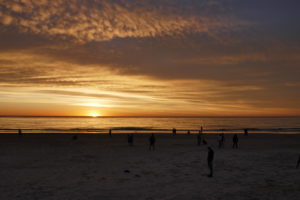
Having an ice cream on the beach and watching the sunset is like watching an open fire. You are inexorably drawn in. On my last night the ‘super-moon’ rose behind the town and the sun set in a flaming blaze of colour over the sea. The planets in line.
And as you would, we all stood to face the setting sun, raised our hands and applauded the end of another day. It’s what they do here.