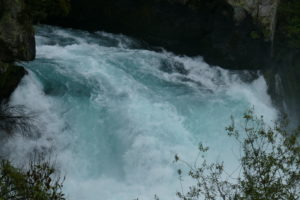
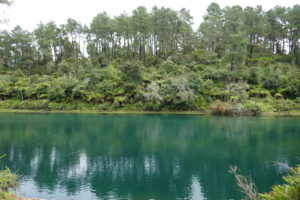
Leaving the ‘Pacific Coast Highway’, I’m now on the ‘Thermal Explorer Route’, crossing the centre of North Island. Here seismic activity is at it’s most visible. Arriving in Taupo I take advantage of an hour without rain and visit the Haka Falls, a narrow, rock gorge at the edge of the (vast) lake where turquoise water squeezes through at high speed. Pretty powerful stuff. Avoiding bus loads of Chinese tourists I walk along the very pretty river and come across a thermal tributary. The stream is steaming, hot water ! A few brave souls in swimwear are installed at the intersection, but the grit and dirt does not appeal.

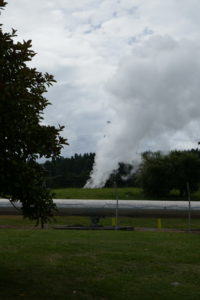
Driving away, I pass a field full of people learning to ‘zorb’. For a split second I’m in the Benny Hill Show. Enthusiastic folks with giant plastic globes on their heads careering blindly round, falling over and rolling down the slope. A comedy vignette and I laugh out loud. Down the road the local power station is shrouded in steam, escaping from the huge pipes moving hot water around. There are warning signs about scalding water which make the pipes too hot to touch. Amazing !

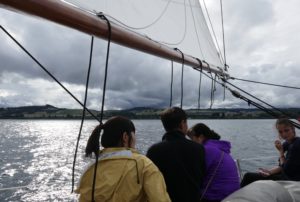
My evening is aboard a 1926 vintage Colin Archer wooden yacht. Legend says it was once owned by Errol Flynn who reputedly won it in a card game. It’s had a refit or two to suit it’s current life on the lake. It’s a sad sight to my eyes. Why a flat screen TV ? No longer the lady she once was. We sail for a couple of hours to reach some mighty impressive rock carvings overlooking the lake. Described as Maori, these are actually 1970’s vintage, carved by artists in the Maori style, but they are no less interesting. As we head back our skipper educates us on the lake itself* A massive volcanic caldera, the eruption that created the crater also caused a mini ice age. It’s pretty huge. You cannot see the other side of the lake; it’s over the horizon. It’s barely surveyed as it’s so deep: up to 180m in places, where it has. A few metres from the rock face, we are in c50m of water.
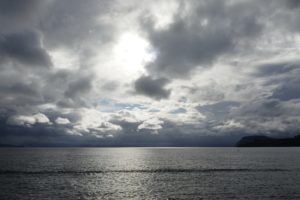
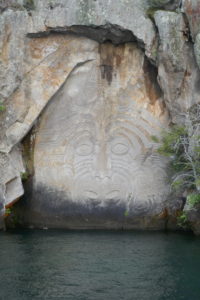
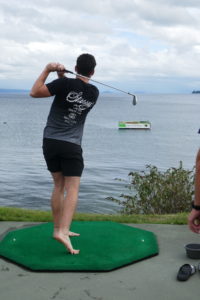
Walking back to my motel, I pass the hole-in-one golf challenge on the lakeside. Out on the water is a floating platform, grassed and with a flag in the middle. I wonder how they manage to locate the vast majority of golf balls that must miss this swaying target.
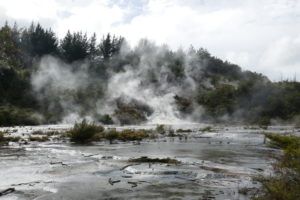
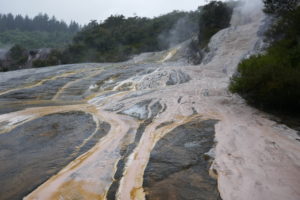
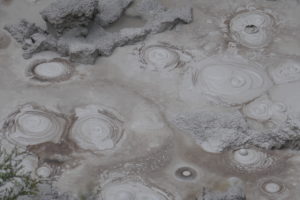
Heading on to Rotorua, I detour via Orekai Karako**, an attraction lightly touched by tourism, but capably showcasing the natural geothermal activity famous in New Zealand. Approaching by boat, the boiling water, geysers, mud pools, springs and limestone features are surrounded by thick rainforest, which makes it all feel wild. We get the sense the Maoris would have seen the tell-tale steam rising from the forest in just the same way. Exposed limestone rocks are a kaleidoscope of mineral salt colours and natural heat radiates through my clothes. In the torrential rain I can appreciate, with boiling water everywhere, Maoris wouldn’t need to light a fire ! The smell is sulphurous, but not overpowering. Back on the other side of the lake we watch eels swimming in the water. A Maori favourite food. Off the main road and away from the tourist trail, this is a great find.

In Rotorua the sulphur is strong and pungent. The rain is biblical and my view of the lake ends about 20m off the shore. Anticipating another night of limited options for activities, I’m booked onto a ‘Maori Village Experience’*** which is largely undercover. Designed for the tourist market, it’s a tad cheesy, but educational nevertheless. Owned by one extended Maori family, they run a slick operation.
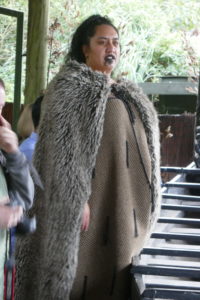
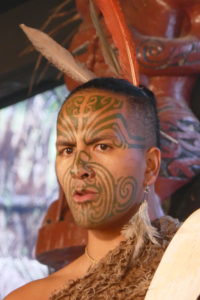
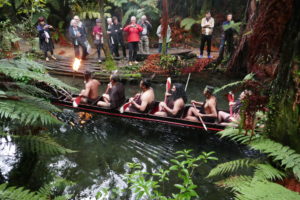
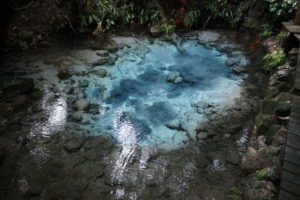
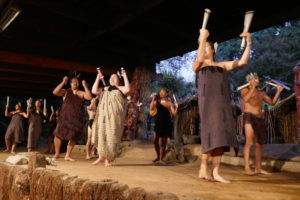
I get to rub noses (‘hongi’) in greeting and eat a meal that has been slow-cooked over hot stones underground (‘hangi’). We see a cold water spring, bubbling up from the ground, full of rainbow trout. On the adjoining stream Maoris in traditional dress and tattoos arrive in a war canoe, with a flaming torch, chanting and shouting. In a reconstruction of a traditional village we are entertained with a show; from the ‘Haka’ (literally ‘breath of war’) to a love song and dancing. Their voices are powerful, harmonious and very moving. Throughout we hear about Maori traditions and customs, which gives context. Later, on Maori TV, I discover there is an annual, national contest between tribes where they sing and dance their hearts out. It’s taken really seriously. I like to think of it as a sort of Polynesian Eisteddford.
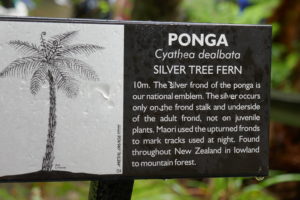
Late in the evening as the rain stops we are led into the bush and our our eyes adjust to the darkness. New Zealand’s national symbol, the silver tree fern grows here. A simple demonstration reveals how it all but glows when the silvery underside of the leaf is visible. After dark Maoris use these like sign posts on the forest floor, to light their way.


In the blackest recesses of the trees, glow-worms twinkle like stars in the sky. How do they do that ?
*https://en.wikipedia.org/wiki/Lake_Taupo
**https://www.orakeikorako.co.nz/