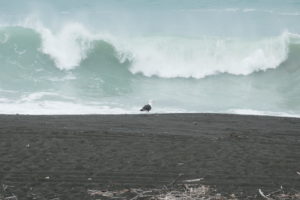
The rain is unending. Having miles to drive means I can stay dry, mostly. Seeing the ‘sights’ is challenging, if not impossible. After leaving Whatakane, I locate a black sand beach at Opitike for a stroll. For a short while I can actually see White Island*, the active volcano offshore, with a wisp of smoke above it. So it exists, then.
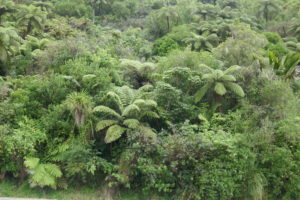
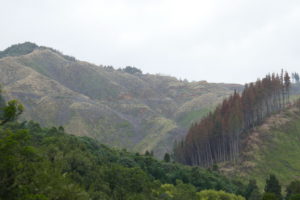
Driving from the Bay of Plenty to Hawkes Bay, I pass through a wonderfully green and lush gorge. The road winds constantly, the scenery distracting. Logging lorries, with one or sometimes two trailers, come hurtling round corners, taking no prisoners. They are behemoths and I’m not about to argue with one. Best concentrate, then. Then I encounter roadworks where resurfacing is approached by first ripping up the whole road. Without a contraflow, we are plunged from perfectly good tarmac onto rocky, muddy, wet loose stuff. 30km/ph is slow, but only just controlled. With all this rain it’s a wonder there’ll be anything left to surface ! My white car is now brown. Eventually the landscape turns agricultural, with green hills, cattle, sheep and lots of big brown eagles. Kiwi fruit, avocados, sunflowers and grapes the produce of choice.
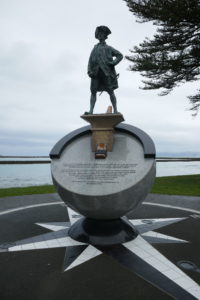
Arriving in Gisborne, I find Captain Cook. There’s a rather fine statue to him at the entrance to the harbour. I’m pleased to have a friendly face in town. Other than that it’s an unremarkable place, but now I know where all the timber lorries go. The quayside is stacked with lumber as far and high as the eye can see. A cruise ship is in harbour, but bless me, I’ve no idea why. A nice clock tower graces the centre of town. Maybe that’s it.


Down the coast towards Napier the beaches are gorgeous, but with continuous wet and windy weather, the surf is up and the sea angry. There are few swimmers. Once in Napier the sun shines for more than a couple of minutes and it’s a pretty place. Flattened by a huge earthquake in 1931, the rebuilding programme was significant and of it’s time. Art Deco. Logically most buildings are from that era and the town is now actively trying to preserve as much as possible. Napier is renowned for it’s annual Art Deco festival**, with all things thirties and jazz. Sling a fox fur round your neck, find an old car/plane and you’d be right in there. I join an evening walking tour which is very interesting, but few buildings are untouched by progress and plastic. Many other towns also have architectural gems hidden behind modern ‘improvements’. This is just a another, but with better marketing.
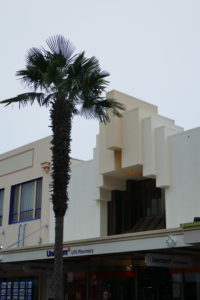
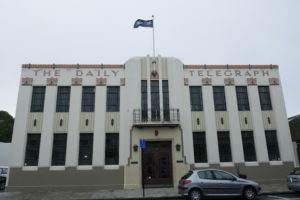

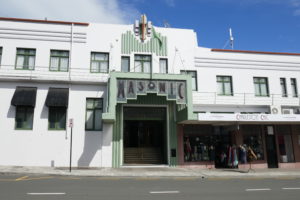
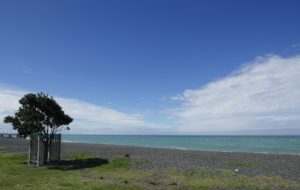
One fascinating takeaway is the impact of the earthquake on the local geography. A large lagoon lay north of the town, indeed old Napier was all but an island. In the Art Deco centre marvellous film footage shows sailboats racing on the lagoon a couple of days before the eruption. A few days later the area is all above water as the underlying land rose 2m ! It’s now the local airport. Amusingly a few navigational beacons, looking like small lighthouses, still stand on the flat land where once they were surrounded by water. Surreal.
*https://en.wikipedia.org/wiki/Whakaari_/_White_Island
**http://www.artdeconapier.com/events.html