South Georgia is a gem. Shaped like a fat banana, there are inlets and glaciers alternately gracing both coasts. The island lies NW – SE and the SW facing coast is storm wracked and inhospitable to most. There are 2 BAS (British Antarctic Survey) research bases on South Georgia. Only a very small handful of people brave the Antarctic summer (yes, we are here in summer) to man these posts and carry out their research.

At the far NW corner of the island that Sir Ernest Shackleton landed with his men, in 3 very small boats, hoping to find civilisation after a treacherous sea journey from Antarctica, via Elephant Island. His ship, the Endurance, had broken up after 18 months trapped in the unusually thick ice of the Weddell Sea and he had to find help. He was to be disappointed, initially. The whaling stations were all on the more sheltered NE facing coast of South Georgia. For this final stage, he and a handful of men, who had reached the island in the small boat ‘James Caird’, were exhausted and malnourished. It was winter. Undeterred, they climbed over the mountains to reach Stromness whaling station, where help was eventually at hand.
On our visit we retraced the final few miles of that walk, up and over a snowy pass, down a very steep, shale slope. Seeing the whaling station appear in the distance, one can only imagine the elation they felt. Reading some of their contemporary accounts, it is all the more astounding that the whole crew of the Endurance survived their many ordeals and Shackleton made it here. We are truly moved.
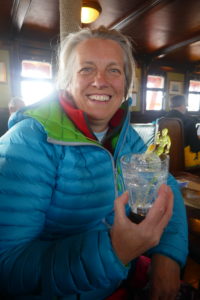
In celebration we drank water from ‘Shackleton’s waterfall’. Followed by some chocolate. Well, why not? There was so much ice & snow back in 1916 they abseiled down.
Like Shackleton on his outward journey, we headed towards Antarctica, having left South Georgia behind. We, too, found the ice in the Weddell Sea a bit of a challenge (!) and so our guides thoughtfully added in a bonus stop (Plan C invoked) Elephant Island. This was unexpected and a treat for our Shackleton fans. Overnight Klaas had moored Europa close to Point Wild, the tiny beach where 22 of the Endurance crew made camp whilst their leader sailed on for South Georgia. On deck at 5am, the water was flat calm, the sun was picking out the mountain tops and a glacier in the bay towered above the shimmering sea. No sign of a beach.
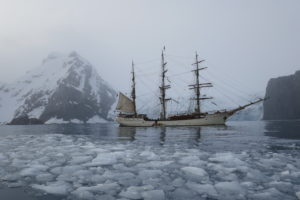
The guides felt a landing was not possible so a ‘Zodiac Cruise’ it would be. A superb decision! Nosing away from the ship, we encountered a lot of floating ice. Jordi, our guide, negotiated the way through, stopping to pick up a few pieces and explain the different sorts of ice graunching at the propellor! One piece the size of a football was crystal clear and full of decent sized bubbles. This was thousands of years old glacier ice, dimpled by the action of the waves. ‘Golf ball ice’. We kept it in the boat with us. As it melted, the sound of popping bubbles released ‘old’ air into our atmosphere. Remarkable. We motored along the glacier face to marvel at the shapes and fissures, but not too close in case a chunk ‘calved’ into the sea near us. We were safe.
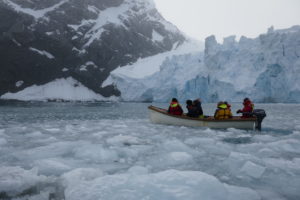
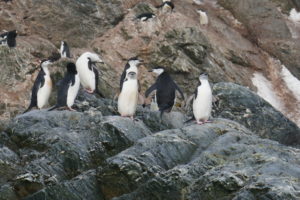
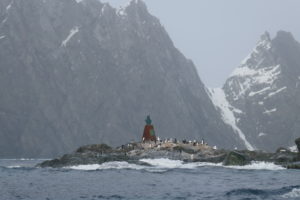
So where was this famous beach, then ? We knew a landslip had covered some of it, so there was not much to see. No kidding ! Jordi took us round a couple of rocks which smelled strongly of fish. Ah ! My favourite. Chinstrap penguins. Lots of them and their fishy smells. Still no beach. Hang on there’s bust and plinth on that low bit of ground linking the cliff to the ‘chinny’ rocks…are we near ? Can’t see anywhere you could land, let alone set up a small camp. And that’s the point. We were dodging huge rocks under the surface. Getting close to shore was a big ask. Jordi pointed out the ‘beach’. ‘Really? Is that it?’. If there was a cat on Elephant Island, there was no room to swing it here.
So here in 1916 22 men made shelter from 2 upturned rowing boats on a miniscule strip of land right at the waters’ edge, catching seals and penguins as their only food and fuel. Close to starvation and cut off from the world, they clung onto life by their fingernails. But they did have a banjo.
Every day their leader Frank Wild would say ‘Tomorrow the boss will come’. And he did. After 135 days the Chilean tug ‘Yelcho’ appeared in the bay with Ernest Shackleton aboard. This was his fourth attempt to rescue his men. The bust is of the Chilean tug skipper, Captain Pardo.
As we head back to Europa, marvelling at all of this and chuckling at the penguins leaping out of the water around us, a ship appears in the bay ! No, not a tug, but only the second vessel we have seen since Montevideo. This is the ‘Hebridean Sky’, a small cruise ship and it’s their turn to explore Point Wild. We quickly weigh anchor, the wind picking up and sky closing in as we motor away. We’ve been lucky again.
That night Laura, our lovely barmaid, dons goggles and wielding a lump hammer breaks up the golf ball ice plucked from the sea. In the bar it’s G&T’s all round, with the rarest and most special ice I shall ever taste. The bubbles pop and we all fall silent to listen to the air of past millennia merging with the shipboard fug. I name this ’Wild Elephant Gin’. Those bubbles were trapped in that glacier when Shackleton’s men were similarly trapped alongside it. I bet they didn’t have gin. Makes you think.