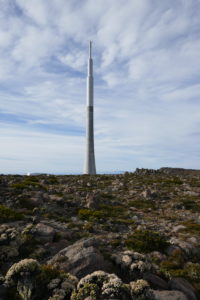
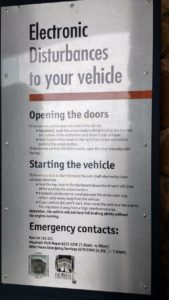
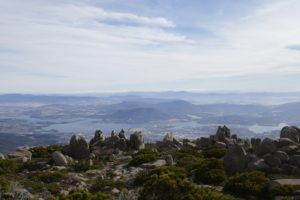
High above Hobart is Mount Wellington, a peak overlooking the south east corner of Tasmania. An early morning drive to the top is worth the punishment on the hire car. A big comms tower sits at the top, like a giant needle. Close up the signs in the car park warn that central locking and electronic ignition may well be knocked out by this. Hmmm.
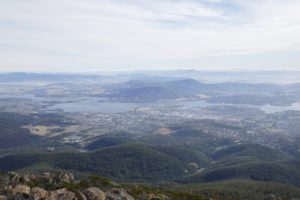
I get out of the car and the wind almost knocks me off my feet. Blimey! But it’s worth the effort to keep at least one limb in contact with the ground. The view is spectacular and I’m glad I made the effort. I can even see the peninsula of Port Arthur in the distance. Relieved to get back in the car and find it fires first time. It’s a long walk down…

The drive west is long and winding, through endless bush and forest. This is one of only 2 roads out of Hobart this way. The rest is forest. Most of the south west of Tasmania is protected habitat. Even 4WDs have their work cut out here. Self-sufficiency is essential. The road kill count is rising, which does not surprise. Some hill names surprise though. A large one is called ‘Break-me-neck-hill’ on one side and ‘Bust-me-gall-hill’ on the other. I chuckle. A small town yields a cafe and a stand-alone self-serve 24hr petrol pump. All bases covered for the traveller.
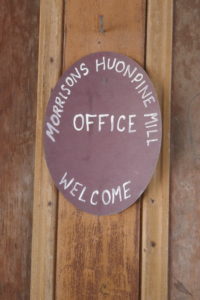
Down a dirt track in the forest is something amazing. The Wall in the Wilderness* is a labour of love by artist, Greg Duncan, carving Tasmania’s native Huon Pine**. Housed in a slick, beautiful, purpose-built wooden gallery with the whiff of woodsmoke coming from the open fire, the setting is perfect. Duncan has spent the last 10 years carving a series of 3m high panels depicting scenes from the world around him. Some are of wildlife, flora and fauna, others reflect the hard lives of the early settlers in Tasmania and their industry. A number of panels are unfinished, demonstrating the carver’s craft. The completed reliefs are breathtaking. His images are beautifully observed, with minute attention to detail, yet the panels are uncluttered. Photographs are not allowed, so the images are in my head. Some tell a powerful story of hardship and loss. Voices are hushed. The woman behind me gasps audibly at every panel. I should be irritated but I think I’m doing the same. This place is extraordinarily moving. I buy a couple of postcards as momentos. The artist takes my money. Oops, hope I didn’t gasp at him !

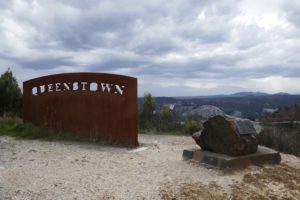
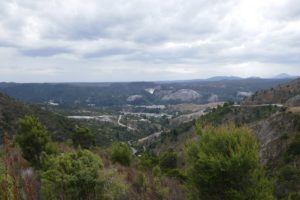
Arriving in Queenstown is like landing on the moon. This is mining country and vegetation is scarce. All around are terraces of rock and the river runs yellow from the exposed minerals and mud. The town centre has seen very much better days. My motel is straight out of the 1970s and defiantly staying there. It starts to rain. This is miserable. I discover the local airport but can’t see the tarmac for long grass. The gate is locked. No, not the most cheerful place I have been to.
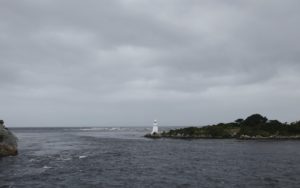
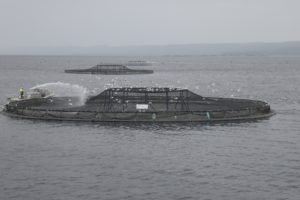
A boat trip on the Graham River promises distraction. Macquarie Harbour is a big river estuary with a treacherous, narrow entrance known as ‘Hells Gates’. Our skipper takes us through, past two lighthouses, boiling seas trip over several sandbars and I’m shivering at the potential for disaster. A pair of dolphins sneak past, unseen by the rest of the boat. Hello boys! We peel back into the harbour, motoring past enormous salmon farms and make our way to Sarah Island.
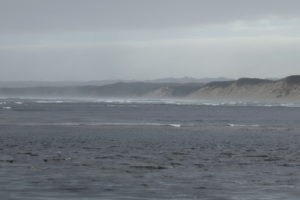
Pre-dating Port Arthur as a penal colony (1822), Sarah Island was a harsh, harsh place for convicts. And the jailers were an unsympathetic lot. A small island, escape was either via miles of thick, jungly forests surrounding the harbour for miles or out to sea, through Hell’s Gates. Neither presents a great option. Flogging was used extensively to ‘manage’ the inmates. 1,000s were recorded every year. Our guide gives us a graphic description of how a cat of nine tails would be tripled then have pieces of lead inserted into the leather ‘tails’ to inflict maximum injury with fewer lashes. Frequently the miscreant would receive enough lashes to be very badly injured, then returned to confinement until the wounds healed. Then they could receive the next tranche of lashes from the original sentence. Completing a sentence could take months.

It takes a Scottish boatbuilder, David Hoy, to recognise the huge resource in Huon Pine locally and the lack of trained boatbuilders to exploit it. Huon is very strong, pliable and contains natural substances resistant to gribble and toredo worm, which happily eat their way to shipwreck. Soon he begins to train the inmates of Sarah Island and far from building boats for escape they conform to a more peaceful existence. Misdemeanours and floggings plummet. He turns things around. The wood is still worked here, but no trees are felled any more. Huon grow very slowly, c1cm per year, indeed some trees are known to live up to 3,000 years.

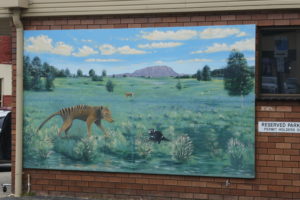
Next day I’m up early, keen to get away from here. Hoping for an interesting drive back to Launceston airport I’m disappointed. The rain clouds are so low my planned walk at Cradle Mountain is off. No sign of anything above 100feet. Roadkill features fresh and furry every km. Depressingly furry. Sheffield is the next town of note. ‘Town of murals’. Not my thing. Then it’s Railton; ‘Town of topiary’. Dear god… This is not the Tasmania I arrived in a week ago. I want to scream at the top of my voice. I’ve enjoyed this island state but the airport can’t come soon enough.