After 7 weeks of 30° plus every day and wall to wall sunshine, my personal heatwave breaks. Stepping off the plane in Launceston (sorry my Cornish pals, they pronounce it ‘Lawn-cess-ton’. Yes, agree…) it’s 18° but feels more like Antarctica. Brrr. I’m in Northern ‘Tassie’ and heading south, so it’s unlikely to improve. I collect my shopping trolley for the week and Mrs Google takes me back in time to my motel. It’s pure 1970’s and not in a good way, but they must love it as the bedside lamp is screwed to the table. Oh well. A walk into town reveals a lively little place, with lovely old houses and lots of eateries. There are even Japanese monkeys in the park. Apologies, I didn’t find out why, but there must be a story.
Escaping early next day, I head north up the Tamar estuary. It’s very attractive, renowned for great dairy produce. Near the mouth of the river are two tourist attractions I can’t resist: Seahorses and Platypus. Long ago I decided it unlikely I’d see either in the wild, so I’ve coughed up for a closer look. Two grey sheds on the quay contain some amazing creatures. Our seahorse guide tells us many facts, few of which I retain. One is males fill their stomachs with water to attract females. Thus females have the 6 pack and males have a beer belly! This is also a hatchery so we see all sizes and shapes and get to handle an adult seahorse. The tail grips you firmly, like an infant’s hand round your finger. Feisty fellows.


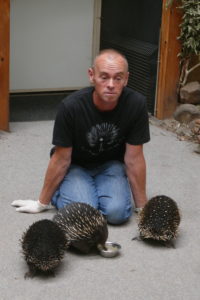
Next door are the platypus. We see three close up in the water. With poor eyesight they use their bills to sweep back & forth like manic, underwater vacuum cleaners, always on the go. For such a cute, furry marsupial, they possess sharp claws on either side of their tail which ping out when threatened, emitting a very poisonous venom. On a level with that of a green mamba snake, an adult human would endure c9 months of continuous excruciating pain, with death certain for child or weaker person. Less cute now. In another area we meet 3 echidnas and watch them being fed. Like large hedgehogs, they have long thin pink tongues they flick out to get their food. They scurry around our feet and we are pleased to learn they are not so dangerous!


Having deviated north, I turn south and it’s a long day’s drive, but the scenery and wildlife is interesting. Once over the delightfully named ‘Batman Bridge’, the roads wind endlessly through agricultural pasture, lined with huge gum trees. Higher up there are ferns, so more tropical, but everywhere are rusting tractors and dilapidated farm sheds. With so much space I guess there is little compulsion to tidy up. My wildlife tally is good; a wombat ambles down the side of the road like Paddington on all fours. I’m giggling. Black swans feature on every stretch of water and black parrots are the sunset chorus as there are no cicadas. Roadkill is everywhere. Probably an average of one per km. Wallabies, Tasmanian Devils, Pademelons, Kangaroos and any number of other small marsupials I don’t recognise. Bookshops stock a roadkill cookbook here*, such is the availability of fresh meat, although eagles tend to get first dibs.
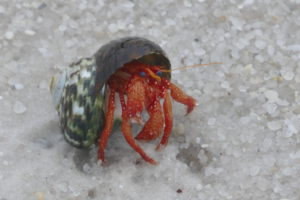
At the east coast and feeling beach withdrawal I locate Binalong Bay. Nice squeaky soft sand with a colony of hermit crabs. This is at the southern end of the Bay of Fires, named not because of the vivid orange lichen on the rocks, but because settlers saw Aboriginal fires along this coast. Nearby are Humbug Point and Piccaninny Point There’s a good line in crazy place names when not re-using the old-country ones. I drive through Beaconsfield, Derby, Falmouth and Exeter before reaching Bicheno, my base for the next 2 nights.
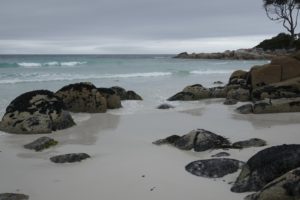
I’m delighted to discover Little Blue (‘Fairy’) penguins live here. I resist the temptation to visit them, despite being a new variety for my list. Instead I’m up with the lark and off to Freycinet peninsula national park for some walking and good coastal views. A small kangaroo meets me as I get out of the car to put my boots on. Consulting the walking options I go for the 11km, 2 beaches option, but tackle in reverse to avoid the hordes already parking up. After 2 hours I meet my first human. Bliss. A short while later I spot a cove with crystal clear water, so can’t resist a detour to drink in the beauty. A twig snaps by my foot. A fairy penguin is on the ground and trying to make it up the beach, but his back leg is gashed. I retreat to wait. After 10 minutes I decide to move him as he’s stuck. He lets me, but I wonder if I’ve helped or hindered. I will never know.

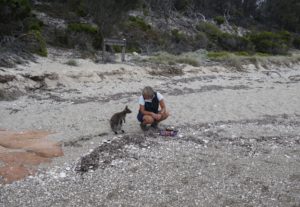
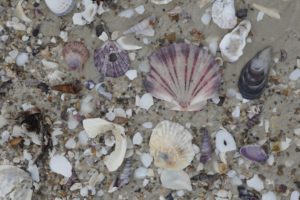
The main beach is Hazards, named after a nearby rock formation. A huge swathe of fine white sand, the beach is groaning with shells, pretty purple, pink and white ones along it’s full length. The sea is calm and soothingly lapping the shore. Paradise ! Beside myself over the bounty at my feet I’m on bended knee, head down when a passing couple ask if I’d like my picture taken. When I look up a wallaby is beside me on the beach, nuzzling my leg. So close he could have had a hug. They take my camera and snap a couple of us. After 10 minutes he ambles off, clearly finding my conversation dull !
After too long sifting through shells and gasping at the bay, I take the track across the isthmus and reach the famous Wineglass Bay. This is a big curve, hence the name and looks to be a good yacht anchorage. Beach bounty is less exciting so I settle for the view with a cormorant for company. And there are more people now. In fact climbing the last part of the track to the lookout over the bay I think I’m in China. Oblivious to anything but their mobile phones and selfie sticks Chinese tourists crowd the lookout areas and try to feed and pet the wallabies, despite the signs (and common sense). I share rolled eyeballs with an Aussie couple before heading to the car, glad of my inverse route planning.
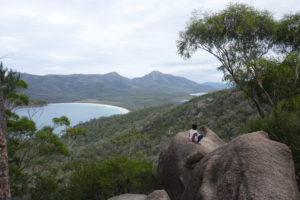
Back in Bicheno the charm of this little seaside community needs investigation. I head off on the coast walk, over huge, flat rocks, beach and track. Past the naval war memorial, another to a brave Aboriginal woman. Past the local school and sports field. Terns and gannets are flying back and forth; there must be something round the corner. Soon I see lots of fishing boats and seabirds, all of a frenzy. A hopeful black swan, pelican and fish eagle are outnumbered about 100 to one. I’ve reached The Gulch, a narrow strip of fast flowing water separating the skinny rock of Governor Island (a marine reserve) and the land. There are fisherman on every bit of jetty and rock, casting lines, hoping to catch a fish as it whizzes past on the tide. A boat is unloading it’s catch and the gulls and terns are crowding round anything remotely edible or likely to be. The smell of fresh chips wafts from benches outside a wooden shack, contented customers licking their lips. I walk on, resisting temptation.
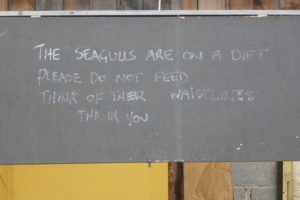
Round the corner the waves crash on the rocks and the bay opens out again. Two retired couples have parked their camper van by the grass, overlooking the sea, lit the BBQ and opened the wine. The public picnic bench is laid with a cloth, crockery and glasses. I reconsider my supper in the cabin and walk back to the shack. They are about to close. $12 (about £7) and a smile secures me a small bag of hot chips and half a dozen of the sweetest, grilled (naturally, local) scallops I have ever had. Each mouthful is divine. An unbelievably delicious supper in an appropriately perfect location. This is the real heart of Bicheno. I’m grinning like an idiot.
*http://www.wrongsideoftheroad.com.au/Roadkill%20Recipes%20.html